


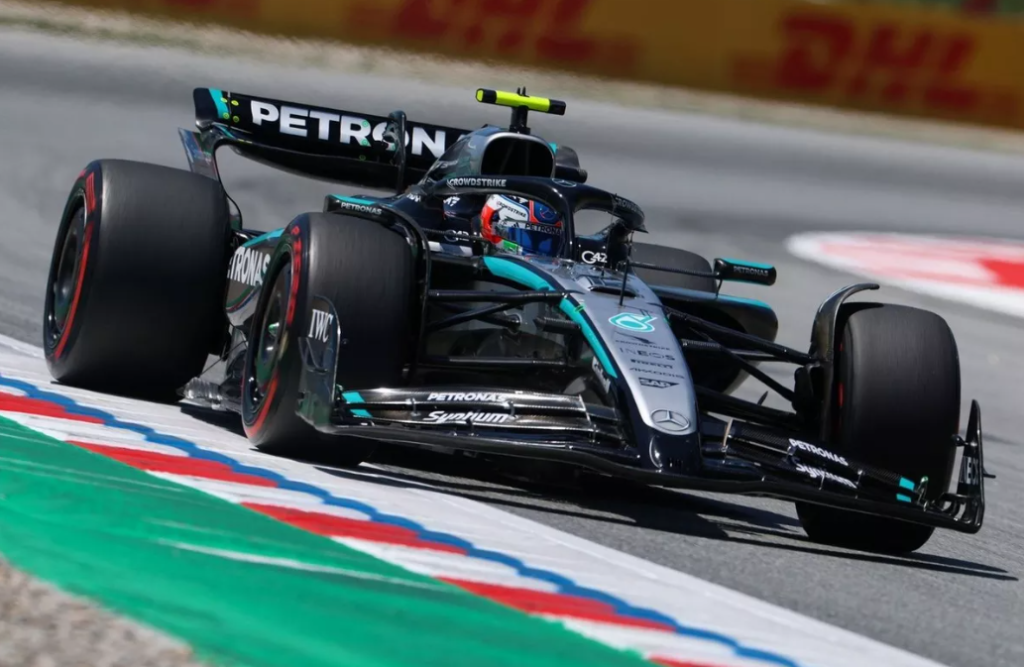
Mercedes’ journey through Formula 1’s ground-effect era has been far from straightforward, and the team’s reliance on flexible wings became both a solution and a setback once the FIA stepped in with tighter regulations during the 2025 season.
After dominating the sport with eight consecutive constructors’ championships, Mercedes found itself on the back foot when the new technical rules arrived in 2022. Its radical zero-sidepod concept proved particularly vulnerable to porpoising, forcing the team into a prolonged battle to regain competitiveness.
As part of its efforts to cure persistent handling issues, Mercedes turned to flexible aerodynamic components. Trackside engineering director Andrew Shovlin explained that the approach delivered clear benefits, especially in improving cornering performance.
Mercedes had struggled to generate effective rotation at low speeds, which in turn caused rear tyre temperature problems. Drivers were often forced to use the throttle to help turn the car, creating further complications. Allowing the front wing to flex provided a way forward, improving low-speed responsiveness while maintaining rear-end stability at higher speeds.
However, that development path was disrupted when the FIA introduced stricter tests on wing flexibility throughout 2025. The most severe measures were enforced around the Spanish Grand Prix, significantly limiting how much front and rear wings were allowed to deform under load.
While some expected the clampdown to derail McLaren’s strong form, that did not happen. Mercedes, on the other hand, felt the impact more sharply. Shovlin admitted the team needed time to adjust once the new tests came into force.
As part of its response, Mercedes closely analysed rival designs, particularly McLaren’s rear suspension concept. The team identified how anti-lift characteristics were being used to keep the rear of the car low through corners, an area Mercedes was keen to improve.
Flexible wings were just one element of a broader set of challenges Mercedes encountered under the current regulations. Shovlin acknowledged that, although the team did not underestimate the difficulty of achieving balanced performance through corners, it failed to carry forward enough of the strengths that defined its 2020 and 2021 cars.
With the field now closely matched in cornering speed, performance differences are increasingly determined by how well a car’s balance suits individual circuits, rather than outright pace.
Looking ahead, Mercedes is already preparing for Formula 1’s next major regulation overhaul in 2026, which will introduce sweeping changes to both chassis and power units. While there is still significant work to be done, Shovlin noted that the challenge now feels less intimidating than it did earlier in the year.